
El Centro City Directory Collections
The verified collection map begins with the Imperial Valley directory run listed by the National Archives. The volumes are dated 1926, 1928, 1930, and 1933 and include El Centro with eight other communities. The California State Library adds searchable city and county directory catalogs and a separate telephone-book catalog. The El Centro Public Library provides the local reference route, although its public pages do not publish a shelf-level directory-year list. Each source answers a different question about where the volume is held and whether a physical visit, reel request, or catalog search is needed.
| Collection | Years or scope | Where held | Access |
|---|---|---|---|
| Imperial Valley city directory | 1926, 1928, 1930, 1933 | NARA inventory and microfilm route | Request reel or access details |
| California city/county directory catalog | Catalog-specific | California State Library | Search Imperial and El Centro |
| Telephone-book catalog | Catalog-specific | California State Library | Search separately from directories |
| Local library holdings | Not published online | El Centro Public Library | Ask reference staff |
| Historical newspaper | 1907 to current title record | Library of Congress | OCR plus page image |
For the source inventory behind the first row, use the NARA city-directory listing.
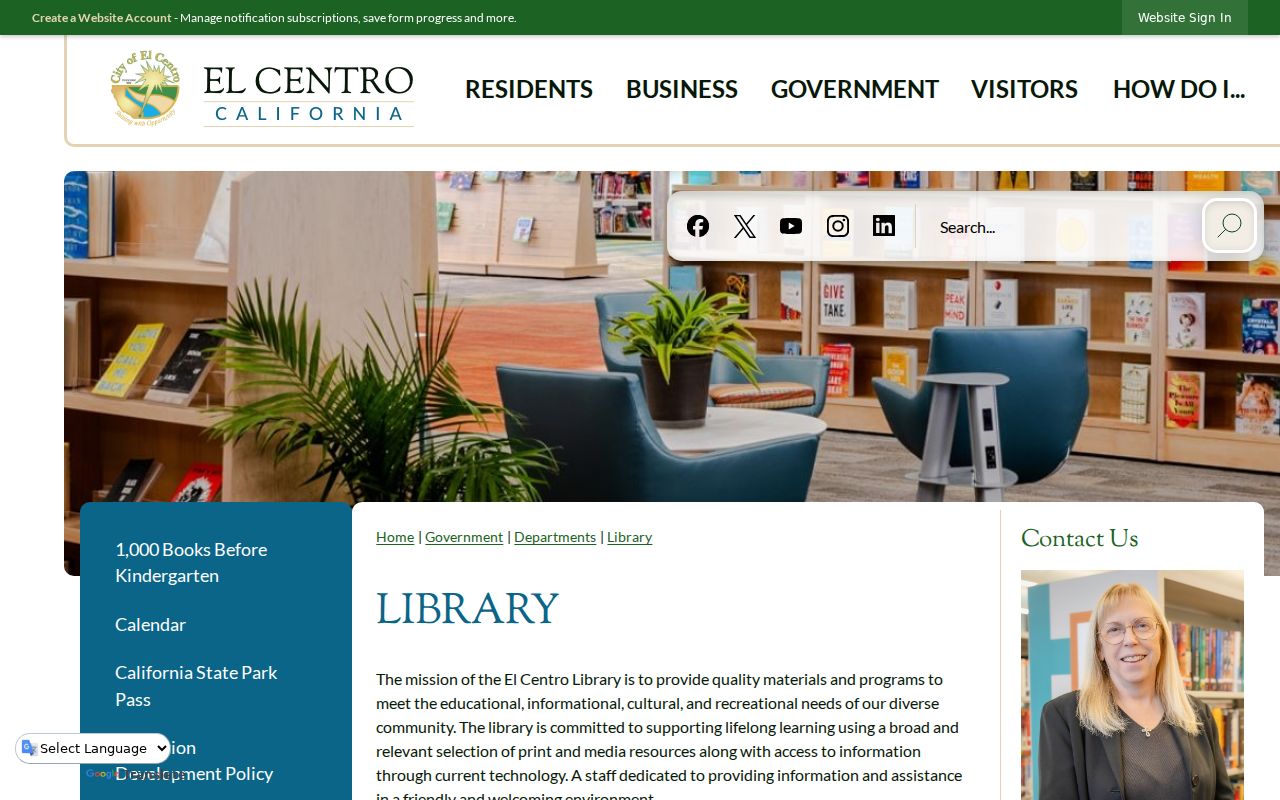
The library image anchors the El Centro city directory in a local reference setting. A catalog hit is a lead to an item, not proof that the volume is on the open shelf or contains a reverse section.
Note: The verified Imperial Valley years are regional volumes, so copy the community label before treating an entry as El Centro evidence.
El Centro Valley-Wide Volumes
NARA calls the run “Imperial Valley,” not simply El Centro. That regional title is useful when a family changes towns. The alphabetical section may include Brawley, Calexico, Calipatria, El Centro, Heber, Holtville, Imperial, Niland, and Westmoreland in one edition. A surname hit therefore needs a second check: read the community label, copy the street number, and compare it with the question being researched.
The regional scope also creates a practical migration trail. A person absent from El Centro in one year may appear under another included community without a new publisher or a new general volume. Search the same four editions before moving to a neighboring county. When the directory and a later deed disagree, treat the directory as an address snapshot and the deed as a title record.
For older county context, the California State Archives lists Imperial County deeds from 1851 to 1907 and marriages from 1903 to 1923 on microfilm, with access also associated with Family History Centers. The Pioneers' Museum and Imperial County Historical Society preserve local photographs and history material, but no authoritative online finding aid was verified for named directory or obituary collections. Ask both institutions what can be consulted before promising a particular volume.
Reading El Centro City Directory Entries
A city directory entry often compresses several facts into a few lines. The field checklist below is a research aid, not a promise that every Imperial Valley edition uses every field. The actual volume and its front matter control. An entry may contain a surname, given name or initial, spouse notation, widow notation, occupation, employer or business, home address, business address, telephone, ownership or occupancy mark, and a cross-reference.
- Name line: copy punctuation, initials, accents, and the order of compound surnames exactly.
- Household clue: note a spouse, widow notation, or shared address without expanding an abbreviation.
- Work or business clue: treat an occupation or office as context, not as a home location.
- Address line: preserve number, direction, street type, apartment detail, and any ownership or occupancy mark.
- Cross-reference: follow it only after checking the edition's key and the page sequence.
Open the page image or reel rather than relying on a catalog summary. A printed directory is evidence from a compilation date. It can place a listed adult at a number, but it does not identify every household member and does not prove that the person owned the property.
El Centro Directory Abbreviations
Definitions are essential because directory shorthand varies by publisher and edition. A householder index is a name-first list of people associated with a home address. A reverse or criss-cross directory starts with the address and points to a listed name, when the edition provides that section. An abbreviation key explains marks such as occupation, spouse, widow, employer, occupancy, or ownership. Do not expand a symbol from memory or from another year's volume.
- Alphabetical section
- Names arranged by surname, usually the first search path.
- Street section
- Addresses arranged by street or number when the volume includes one.
- Criss-cross
- An address-to-name index, subject to edition-specific verification.
- Householder
- The person the compiler selected as the main entry for an address.
- Abbreviation key
- The publisher's explanation of marks and short forms.
If a scanned key is missing, label an interpretation as uncertain. A short mark may distinguish an owner from another occupant, or a home from a business address, but only the printed key can settle that point for the edition in hand.
Note: Never expand an abbreviation from memory when the edition's own front matter or key is available.
Tracing El Centro City Directory Households
A household trail gains strength when the same address, spouse, occupation, and name form recur across more than one edition. The four verified Imperial Valley years are especially useful around the 1930 census. Use the directory for the address snapshot and the census for household relationships, ages, birthplaces, occupation, and tenure fields. The dates are not identical, so a move or a new household can appear between both sources.
- Normalize the name, spouse clue, and approximate date, then search the 1926, 1928, 1930, and 1933 alphabetical sections.
- Copy the exact El Centro street line and read the edition's abbreviation key before interpreting any mark.
- Pair the 1930 directory with the 1930 federal census and compare household members, ages, birthplace, and occupation.
- Search Imperial Valley Press pages around a move, marriage, death, legal notice, business notice, or social item.
- Connect a property owner to the Assessor and Recorder only when the address and legal description line up.
- If the person disappears, search the other valley communities, neighboring counties, vital indexes, probate, and unclaimed property.
Absence can mean a gap year, rural delivery, nonpublication, a changed surname, or a move. It is not, by itself, proof of death or departure.
El Centro Directory and Census Pairing
The 1910 census is a particularly dense early source because El Centro had incorporated only two years earlier. NARA's field description includes household relationships, age, marital and fertility information, birthplace, parents' birthplaces, immigration and citizenship, language, occupation and industry, literacy, school attendance, and home or farm tenure. Those fields can distinguish two same-name people and show a household that a city directory compresses.
The 1930 pairing is the most direct match for the verified directory run. Compare the census address and household with the directory's listed adult, then use deeds, newspapers, or vital records for a later event. The 1890 federal census cannot fill the area's pre-city gap because most schedules were destroyed after a 1921 fire and El Centro did not yet exist as a city.
Use the NARA census field guide to understand what a schedule can confirm and what depended on the informant's answer.
El Centro Library Catalog Search
The El Centro Public Library's Polaris catalog is the practical local title search. Try the exact phrase “city directory,” then try “Imperial,” “Imperial Valley,” “telephone directory,” “yearbook,” “newspaper,” and a surname. A catalog result may be circulating, reference-only, digital, off-site, or unavailable during a collection move. Ask reference staff to confirm the item, year, publisher, format, and permission to photograph or copy it.
The library is at 1198 N. Imperial Avenue, with reference service at 760-337-4565. Published hours are Monday through Thursday 10 a.m. to 7 p.m. and Friday through Saturday 10 a.m. to 6 p.m.; it is closed Sunday. The city page does not claim a dedicated obituary index, reverse-directory run, or licensed genealogy database, so those holdings need a direct question.
Search the El Centro Polaris library catalog before assuming a directory is absent. Catalog results and shelf confirmation are separate steps.
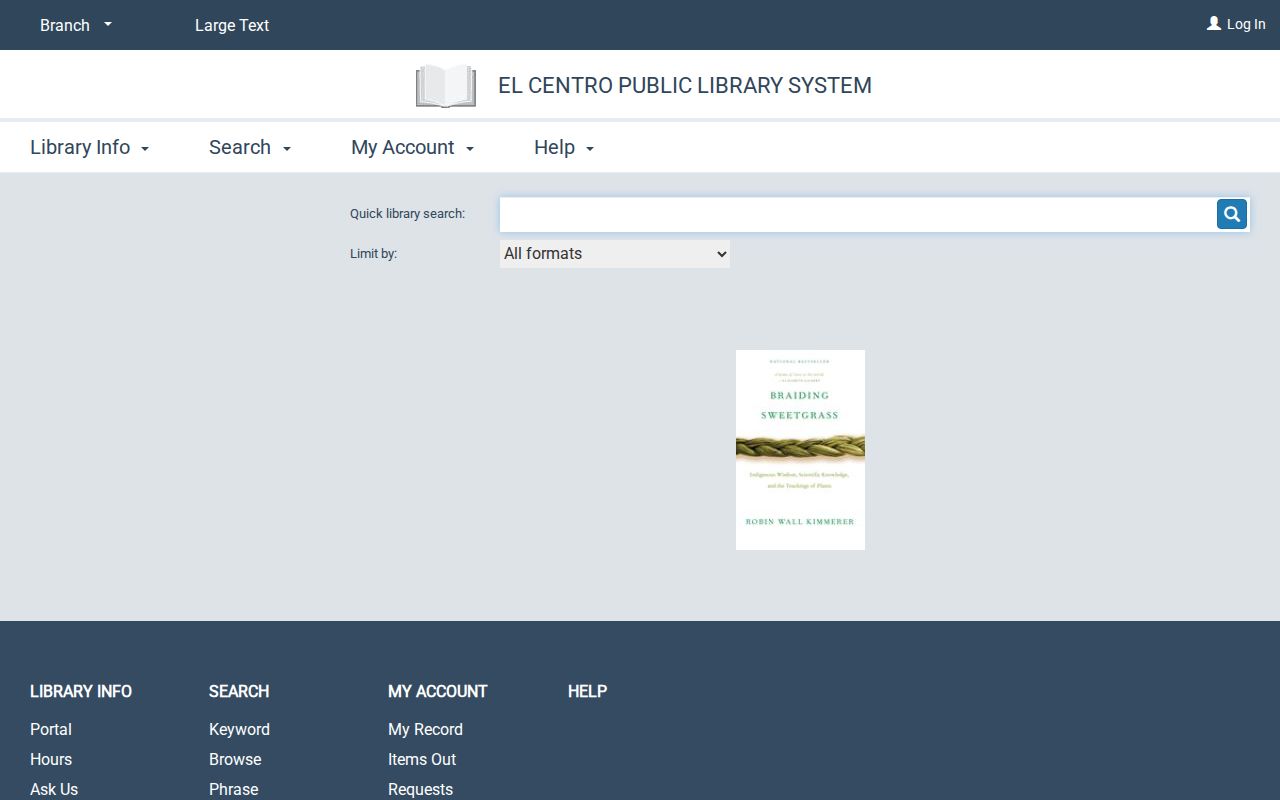
The catalog image shows the searchable layer behind an El Centro city directory request. It supports title discovery, while the reference desk confirms the physical item and its access conditions.
Note: A catalog result can be reference-only, off-site, digital, or unavailable during a collection move, so ask before traveling.
El Centro Directory Newspapers and Obituaries
The Library of Congress record identifies Imperial Valley Press as an El Centro newspaper beginning in 1907 and provides digitized pages and OCR. Search a surname with spelling variants, then add a street, spouse, lodge, school, church, funeral, probate, or cemetery term. Obituaries can suggest relationships. Legal notices can name heirs, trustees, and parcels. Advertisements and social columns can show business and community connections between directory years.
OCR in narrow newspaper columns is error-prone. Open the page image, copy the printed spelling, and record the date and page. No official online El Centro obituary index was verified. The library may have microfilm, clipping files, or licensed databases, but those holdings require confirmation rather than assumption. Cemetery memorials are leads; verify a death with the county or state certificate, an obituary, cemetery office, or church register.
Use the Library of Congress newspaper calendar as the newspaper starting point.
El Centro City Directory Custody
Collection location has a local history. The former library at 539 State Street was constructed in 1911 and was badly damaged by the April 4, 2010 magnitude-7.2 earthquake. Limited service moved during the long closure. The replacement library at 1198 N. Imperial Avenue opened on November 10, 2022 after a $17 million, Measure P-funded project. A directory researcher should ask where old directories, newspapers, yearbooks, and vertical files were stored during the transition.
This custody break does not mean material was lost. It means a catalog result, a shelf, and an off-site box may be three different access states. Ask for collection history and any restrictions before planning a visit. The city directory is most useful when its edition, repository, page, and reading key are all recorded.
For current library details, use the City of El Centro library page. The historical shelf remains the place to trace past residents, not a shortcut to current personal information.