
El Centro Resident Lookup Coverage
Each record confirms a different fact. The coverage table is a starting map for a one-person search in El Centro. Ownership is not occupancy, a case index is not a conviction, a license address is not a residence, and a certificate is not a current contact record. Start with the narrowest official source that answers the question, then use a second source to check identity and date.
| Record | What it can confirm | Where | Access |
|---|---|---|---|
| Assessment parcel | Assessed owner, situs, mailing destination | Imperial County Assessor | Physical address or APN |
| Recorded document | Party role in a deed, lien, trust, or affidavit | RecorderWorks and counter | Free index, copies by order |
| Voter status | One voter's registration or election status | California My Voter Status | Authenticated self-check |
| Court case | Party connection, docket, filing, disposition | Imperial Superior Court | Name search or case number |
| Vital record | Birth, death, or marriage event | County Clerk-Recorder or CDPH | Eligibility and copy type apply |
| Business or license filing | Entity, agent, registrant, or credential | County and state portals | Free public index routes |
A result becomes stronger when two records share more than a surname. Use a middle name, spouse, matching APN, repeated address, related entity, or consistent date sequence. Keep “possible match” as the label until the custodian record supports more.
Note: The strongest El Centro resident lookup starts with two independent facts, not a name alone.
El Centro Resident Records Check
When an address is known, use the Imperial County Assessor before searching a person by name. ParcelQuest Lite documents APN and physical-address search. Save the APN, situs address, assessed owner, mailing address, legal description, and source date. A mailing address can point to an absentee owner's correspondence destination. It cannot establish that the owner lives at the El Centro property. The Recorder is the authority for the deed and party role.
Run the APN or owner name through RecorderWorks where indexed, then open the document number and compare the legal description. A trustee, business, spouse, or same-name party may appear in the index. A deed grant or quitclaim deed is different from a reconveyance, easement, affidavit, or deed of trust. If the index begins January 2, 1986 and the needed event is earlier, use the Clerk-Recorder counter and historical books or microfilm.
The Imperial County Assessor portal is the property starting point for an El Centro resident lookup. The county mapping desk at 940 W. Main Street, Suite 115, can help with parcel context, but the office will not turn an assessment line into an occupancy guarantee.
El Centro Resident Voter Check
California My Voter Status is built for the voter to inspect a personal record. The form uses first name, last name, date of birth, and a driver's-license or identification number or the last four Social Security digits when applicable. A third party should not use the form as a name-and-address directory. A mismatch may reflect punctuation, a changed name, or an input problem, but the page is not a place to infer where another person lives.
More complete voter-file delivery is purpose-limited under Elections Code section 2194 and related California rules. An approved recipient may receive name, residence and mailing address, precinct, party preference, status, and participation fields. The file does not disclose ballot selections and excludes driver's-license data, state ID data, Social Security digits, unique identifiers, and signatures. Confidential voters and Safe at Home participants require special protection.
For personal status, use California My Voter Status. For a lawful records request, contact the Imperial County Registrar at 940 W. Main Street, Suite 206, (442) 265-1060, and state the permitted purpose before asking about the current application route.
El Centro Resident Court Search
The Imperial Superior Court name-search service requires an account and advance payment. It returns matching case numbers and filing dates and charges each name search, including a search with no result. The public search cannot use date of birth or a driver's-license number. Search spelling variants, then use the case number to move from an index match to a docket view.
For the official entry point, use the Imperial court named-record search instructions.
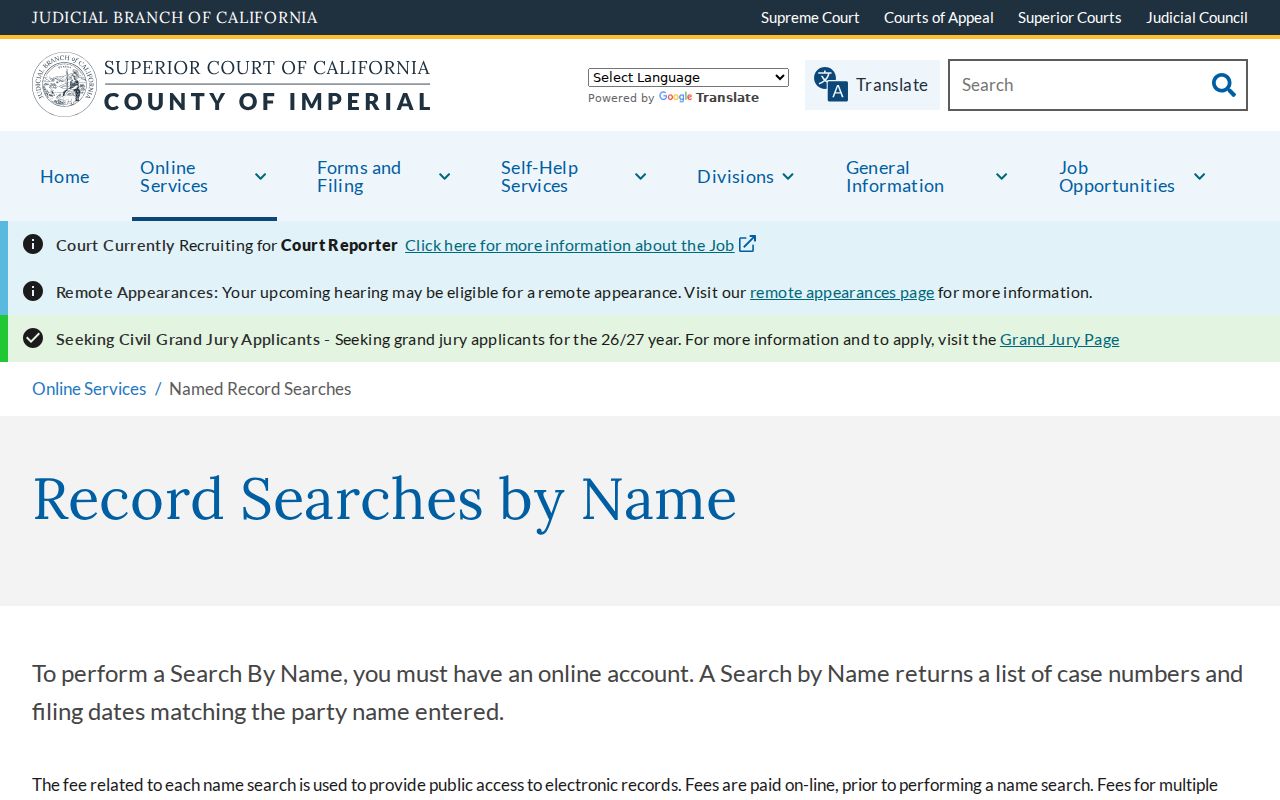
The named-search image shows the paid search layer of an El Centro resident lookup. It returns a possible case connection, not a complete life history and not a substitute for the court file.
If no match appears, do not treat that as proof that a person has no court history. The index may have limited coverage, spelling differences, restricted case types, another county, or a separate federal case. The civil division and criminal division explain their counter routes. The clerk remains the fallback for archived files and certified copies.
El Centro Resident Case Details
A case-number lookup can show more context than a name result. The public template includes case type and filing date, charges and dispositions, case disposition, parties and attorneys, filed documents, probation, hearings and results, judges, sentence entries, time waivers, matters under submission, recused officials, and appellate entries. Compare party type, case date, organization, attorney, and disposition before connecting the docket to a person.
Electronic-file access has separate verification for an active party or attorney and does not expose adoption, juvenile, mental-health, search-warrant, Ramey-warrant, sealed, or confidential material. A courthouse file may be inspectable when a remote result is limited. Court administrative records use a different request procedure from adjudicative case files.
Open the Imperial Court case-number search when a case number is already known. Federal or bankruptcy cases belong in the Southern District of California PACER system, not the Imperial trial-court index.
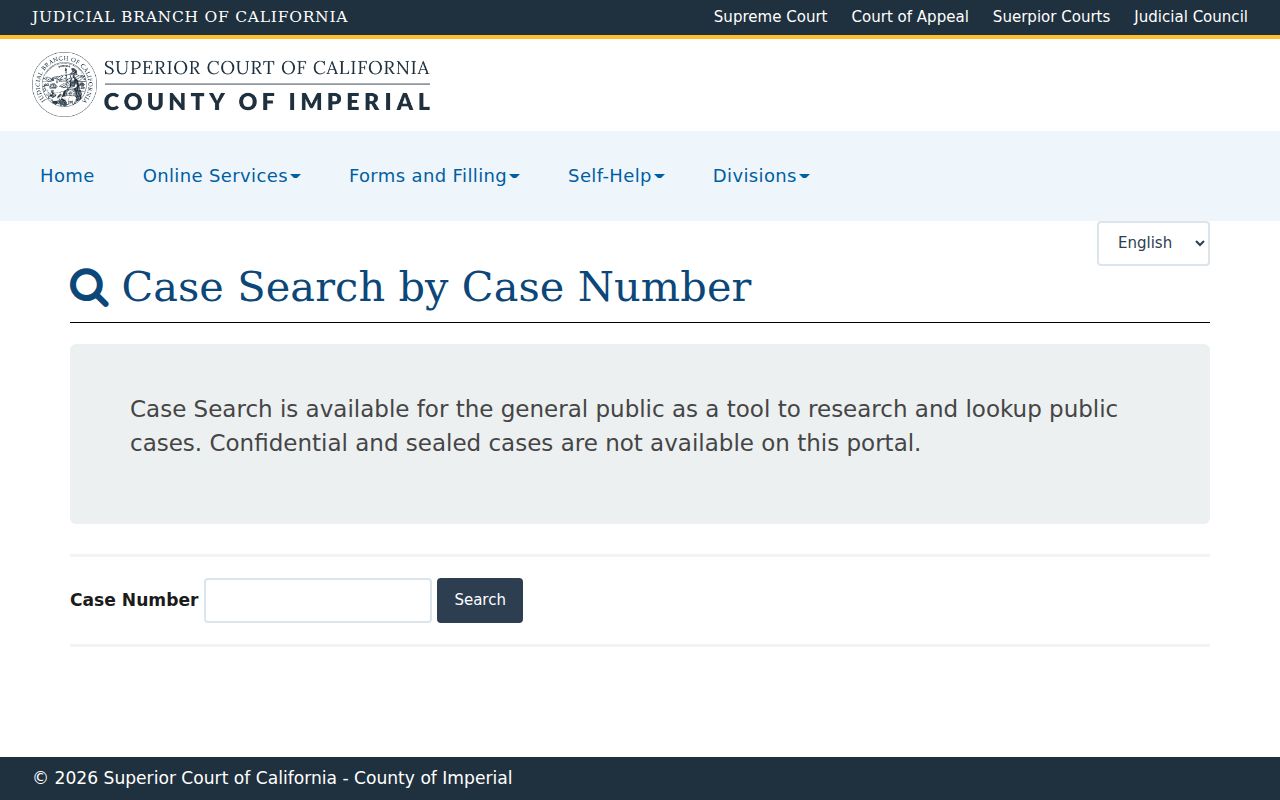
The case-detail image connects a one-person lookup to the fields that help separate similar names. Use the docket and disposition, not a bare search hit, as the meaningful record context.
Note: A case index points toward a file; the clerk controls inspection, certification, sealing, and archived retrieval.
El Centro Resident Vital Records
Vital records can confirm an event, but the copy type controls what the document can do. Imperial County and CDPH distinguish authorized certified copies from certified informational copies. Authorized copies require a qualifying relationship, legal capacity, or other statutory basis and a sworn statement where the application requires one. Informational copies are marked not valid to establish identity. Confidential marriage copies are limited to the parties or a court order.
For a county event, the Clerk-Recorder is often the most direct issuer. Birth, death, public-marriage, confidential-marriage, and divorce routes do not all share one form. The county application asks for event names and dates, event place, certificate type, copy count, requester relationship, purpose, signature, and a notary block for eligible mailed or online requests. A no-record result retains the search fee and produces a Certificate of No Record.
Use the California Department of Public Health vital-records page, its current fee page, and the birth, death, and marriage applications for statewide forms and copy guidance. The county registrars and recorders directory explains local custody. A certificate is event evidence, not a current resident directory.
El Centro Resident Family Trails
A family-history lookup often needs a sequence rather than one record. For an heir, search a decedent's probate case, death record, obituary, and recorded affidavit or deed instrument. RecorderWorks types such as affidavit of death, affidavit of heirship, trustee instruments, and decree-related filings may explain a title change when the indexed party and legal description match. Probate relationships count only when the filed record states them.
For a birth parent or adoptee, California adoption files and original birth records are confidential. Use the official state adoption-information process, CDPH rules, and court procedures rather than searching for an open name list. For a former classmate, start with yearbooks, library collections, alumni material, and newspapers. A yearbook can show school-year presence without supplying a current address.
Unclaimed property may reconnect an heir with an asset, but a name and locality hit needs corroboration from probate, deeds, or vital evidence. A business owner can be cross-checked through Imperial fictitious business names and California bizfile, while keeping agent, business, and residence addresses separate. A custody question follows a different state route through the CDCR incarcerated-person locator or the California Megan's Law site; neither is a general resident directory.
If a municipal permit, code case, archive item, or business-license record is not indexed, use a narrow California Public Records Act request through the City of El Centro NextRequest portal or the City Clerk. Name the department, record type, address or APN, and date range. The city can release nonexempt portions, redact protected details, or explain that the record belongs to the county or state instead.
Note: A lawful request should name the custodian and record rather than ask an office to identify a person for you.
El Centro Resident Name Resolution
El Centro's regional setting makes name variation important. Spanish-language and Mexican-American naming may preserve paternal and maternal surnames, while an index may omit accents, swap order, collapse a compound surname, or record a married or former name. Search each surname, test spacing and hyphenation, and compare dates and co-parties. That is a search method, not a reason to merge two people without proof.
- Docket
- The court's case record and event history, not merely the name-search result.
- Index
- A finding aid with selected fields that points toward an underlying record.
- Certified copy
- A copy issued by the custodian with the status and seal required for its use.
- Situs address
- The physical parcel location, distinct from tax-mailing or business addresses.
Strong linkage usually combines a repeated middle name with the same APN, address, spouse, entity, or date sequence. Clerks can explain search and retrieval procedures, but they should not be expected to declare that two indexed parties are the same person.
Legal Limits on an El Centro Resident Lookup
California privacy rules divide access by record type. Voter details are restricted under Elections Code sections 2188 through 2194. DMV addresses are controlled by the federal Driver's Privacy Protection Act. Safe at Home supplies substitute addresses to qualifying participants; its official FAQ explains how substitute addresses affect agency records. Government agencies can redact protected personnel, investigative, medical, juvenile, sealed, or confidential information. A public deed or court index still has a custodian-specific purpose and should not be republished as a personal dossier.
Lawful personal use. An El Centro resident lookup may support family history, a property question, civic research, or a safe reconnection. Do not use it to stalk, harass, threaten, or intimidate another person. Stop when the record is restricted or the identity evidence is too weak.
Correct an error with the office that created the record: the Assessor for parcel data, the Recorder for recorded instruments, Elections for registration, the court clerk for docket questions, and the licensing board for credential data. The quality of a resident lookup comes from the source trail and the restraint applied to the conclusion.